

In the world of industrial fasteners, the choice between A2 and A4 stainless steel is one of the most common—and critical—decisions an engineer or procurement manager makes. It is not merely a question of part numbers; it is a calculation of environmental risk, mechanical performance, and Total Cost of Ownership (TCO).
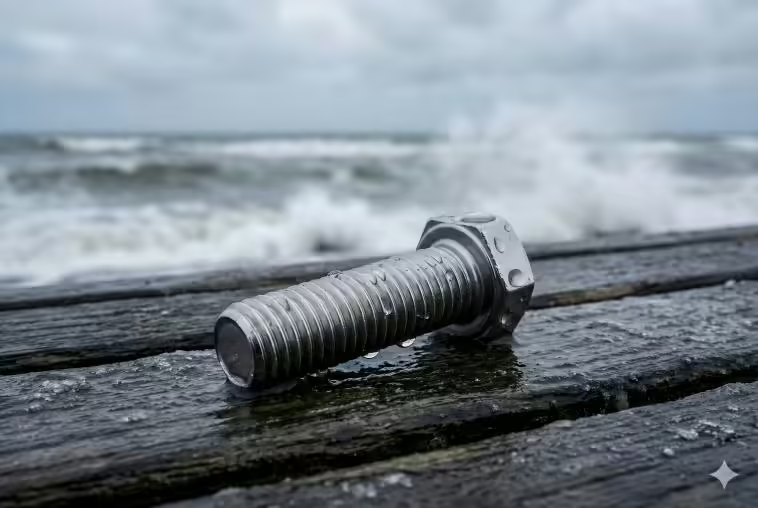
Over my 15 years in the fastener industry, I have seen the consequences of incorrect specifications. I have seen A2 bolts used on coastal structures turn into rusted liabilities within months. Conversely, I have seen procurement budgets bloated by specifying A4 for climate-controlled indoor machinery where it wasn’t necessary.
This guide cuts through the marketing noise. We will analyze the technical differences between A2 (Type 304) and A4 (Type 316), dive into the ISO 3506-1 strength standards, and provide the engineering context you need to make the right choice for your project.
If you are looking for a reliable wholesale partner who understands these technical nuances, we are here to help. But first, let’s get into the metallurgy.
1:The Fundamentals: Decoding the Nomenclature
Before comparing performance, we must clarify the terminology. In the metric fastener world (governed largely by ISO standards), we use the designations A2 and A4. In the US (governed by ASTM/ANSI), you likely know them by their AISI alloy numbers.
1.1 A2 Stainless Steel (Type 304 / 18-8)
A2 is the “workhorse” of the stainless steel family. If you pick up a standard stainless bolt at a hardware store, it is almost certainly A2.
Historically, this is referred to as 18-8 stainless steel. This designation comes from its chemical composition: approximately 18% Chromium and 8% Nickel. It provides excellent resistance to oxidation (rust) in freshwater and dry atmospheric environments. It is non-magnetic in its annealed state, though cold working (the process of forming the bolt) can induce slight magnetism.
1.2 A4 Stainless Steel (Type 316 / “Marine Grade”)
A4 is the high-performance sibling. In the US market, this is known as Type 316. You might also hear it referred to as 18/10 or “Marine Grade” stainless.
The defining difference here is not just the slightly higher Nickel content (10-12%), but the addition of a critical element: Molybdenum (Mo). Even a small addition of 2-3% Molybdenum dramatically alters the metal’s atomic structure, creating a much stronger barrier against chlorides and industrial solvents.
Below is a breakdown of the chemical differences that drive performance:
1.3 Table 1: Chemical Composition Comparison
| Element | A2 (Type 304) | A4 (Type 316) | The Engineering Impact |
|---|---|---|---|
| Chromium (Cr) | ~18% | ~16-18% | Reacts with oxygen to form the passive chromium-oxide layer that prevents rust. |
| Nickel (Ni) | ~8% | ~10-12% | Stabilizes the austenitic structure, improving ductility and toughness. |
| Molybdenum (Mo) | None | 2-3% | The Critical Factor. Provides specific resistance to pitting corrosion from chlorides (salt) and acids. |
2:Mechanical Properties: The “Which is Stronger?” Myth
This is the most common misconception I encounter in inquiries from US and European engineers. Many assume that because A4 is more expensive and corrosion-resistant, it must inherently be stronger than A2. This is false.
Strength is determined by the Property Class, not just the alloy grade. According to ISO 3506-1 (Mechanical properties of corrosion-resistant stainless steel fasteners), both A2 and A4 bolts can be manufactured to identical strength levels.
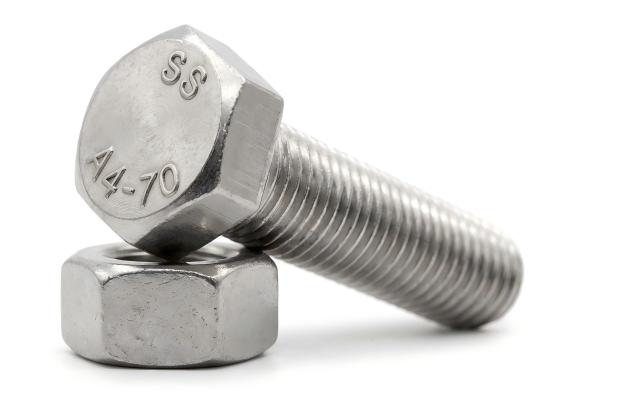
You will typically see markings on the bolt head such as A2-70 or A4-80. Let’s decode what these mean.
2.1Decoding the Markings
- The Letter (A2/A4): Indicates the steel group (Austenitic).
- The Number (50/70/80): Indicates 1/10th of the minimum Tensile Strength in Megapascals (MPa).
Therefore, an A2-70 bolt has a minimum tensile strength of 700 MPa. An A4-70 bolt also has a minimum tensile strength of 700 MPa.
2.2High-Strength Options: The Class 80 Advantage
While Class 70 is the market standard (Cold Worked), we often supply Class 80 fasteners for structural applications. These undergo a more severe cold-working process to achieve higher tensile strength.
An A4-80 bolt is significantly stronger than an A2-70 bolt, but that is due to the processing (Class 80 vs Class 70), not the chemistry (A4 vs A2).
2.3Table 2: ISO 3506-1 Mechanical Property Classes
| Property Class | Material Grade | Tensile Strength (min. MPa) | Yield Strength (0.2% Offset, min. MPa) | Comparison to Carbon Steel |
|---|---|---|---|---|
| A2-70 / A4-70 | 304 / 316 | 700 | 450 | Roughly equivalent to SAE Grade 5 or Metric 5.8 (in tensile only). |
| A2-80 / A4-80 | 304 / 316 | 800 | 600 | Roughly equivalent to Metric 8.8. |
| A2-50 / A4-50 | 304 / 316 | 500 | 210 | Soft, annealed condition (avoid for structural loads). |
Note: If your technical drawing requires high tensile loads comparable to a Grade 8.8 carbon steel bolt, you must specify Class 80. Simply asking for “Stainless Steel” usually defaults to Class 70.
3:Application Guide: When to Specify A2 vs. A4
In our wholesale operations, we categorize client needs based on environmental aggressiveness. Here is the decision framework we use when advising procurement officers.
3.1When to Specify A2 (304)
You should choose A2 if your primary goal is general corrosion resistance at a moderate price point. A2 is the industry standard for a reason—it works perfectly for 80% of standard applications.
- Indoor Environments: Furniture, interior architecture, and warehousing.
- Freshwater Contact: Pumps and valves used in non-saline water systems.
- Food Processing: Commercial kitchens and brewing equipment (provided highly caustic chloride cleaners are not used).
- Automotive: Trim and panels located away from the chassis or road salt exposure.
3.2When to Specify A4 (316)
You should upgrade to A4 if the environment contains chlorides or reducing acids. The price premium for A4 (typically 20-30% higher than A2, depending on Nickel market prices) is negligible compared to the cost of replacing rusted bolts.
- Marine Environments: This is non-negotiable. If it is within 5 miles of the coast, on a dock, or on a ship, it needs A4. Salt mist will pit A2 steel rapidly.
- Chemical Processing: Vats, tanks, and piping exposed to sulfuric acid, bromides, or iodides.
- Medical Equipment: Surgical implants and pharmaceutical manufacturing equipment require the high purity and resistance of Type 316.
- De-Icing Zones: Infrastructure like bridges or street signs in regions where roads are heavily salted in winter.
3.3Table 3: A2 vs. A4 Decision Matrix
| Factor | Choose A2 (304) If… | Choose A4 (316) If… |
|---|---|---|
| Environment | Dry, Indoor, Freshwater. | Saltwater, Coastal, Chemical, Polluted. |
| Budget | Cost efficiency is a priority; risk is low. | TCO (Total Cost of Ownership) is the priority. |
| Aesthetics | Visuals matter, but cleaning is regular. | Must remain rust-free without maintenance. |
| Risk Profile | Failure results in minor maintenance. | Failure results in safety hazards or downtime. |
4:Critical Engineering Considerations
Specifying the grade is only step one. As an engineer, I often see failures not because the wrong grade was chosen, but because the installation or mating materials were ignored. Here are three technical issues you must manage.
4.1 Galling (Cold Welding)
Austenitic stainless steels (both A2 and A4) are notoriously prone to galling. This occurs when the passive oxide film on the threads is scraped off during tightening. The raw metal surfaces seize together, essentially welding the nut to the bolt.
Prevention Strategy:
You should always use a high-quality anti-seize lubricant (molybdenum disulfide or nickel-based). furthermore, reduce the rotational speed of your installation tools. High-speed impact drivers generate friction heat that accelerates galling. Tighten slowly and smoothly.
4.2 Galvanic Corrosion
Stainless steel is “noble” on the galvanic chart. If you bolt an A4 stainless fastener into an Aluminum sheet and introduce salt water (an electrolyte), the Aluminum will sacrifice itself and corrode rapidly to protect the stainless steel.
Mitigation Strategy:
If you must mix metals, you need to break the electrical connection. We recommend using nylon or polymer washers to isolate the bolt head and nut from the base material.
4.3 Welding and the “L” Grades
If your project involves welding the fasteners (for example, welding a stud to a plate), standard A2 or A4 may not suffice. The heat from welding causes “carbide precipitation,” which sucks chromium out of the alloy and creates a zone prone to rust.
The Solution:
Specify the “L” variants: 304L or 316L. The “L” stands for Low Carbon. Lower carbon content prevents carbide precipitation, ensuring the weld remains corrosion-resistant. Refer to standards like ASTM A320 when specifying these grades.
5: The Verdict: Calculating Value
So, which is the “better” bolt? The answer relies entirely on your application context.
If you are building machinery for a factory floor in Ohio, A2 (304) is the engineered choice. It provides the necessary strength and resistance without inflating your Bill of Materials (BOM).
However, if you are designing a solar array for the coast of California or an offshore rig in the North Sea, A4 (316) is the only responsible option. The upfront cost of A4 is an investment in longevity. Saving a few cents per bolt by using A2 in a marine environment will eventually cost thousands in maintenance and reputation damage.
6: Let’s Optimize Your Supply Chain
Navigating international standards like ISO 3506, DIN 912, and ASTM F593 can be complex, especially when balancing cost against performance.
We offer tiered pricing and diverse shipping terms to match your business model. For B2B wholesale, we specialize in DAP (Delivered at Place) via your company’s Tax ID, or we can ship directly to your warehouse agent in China. (Hassle-free DDP shipping is also available for smaller, direct-to-consumer orders).
Would you like us to review your current fastener specifications to identify potential cost savings or performance upgrades? Contact our engineering team today for a consultation.