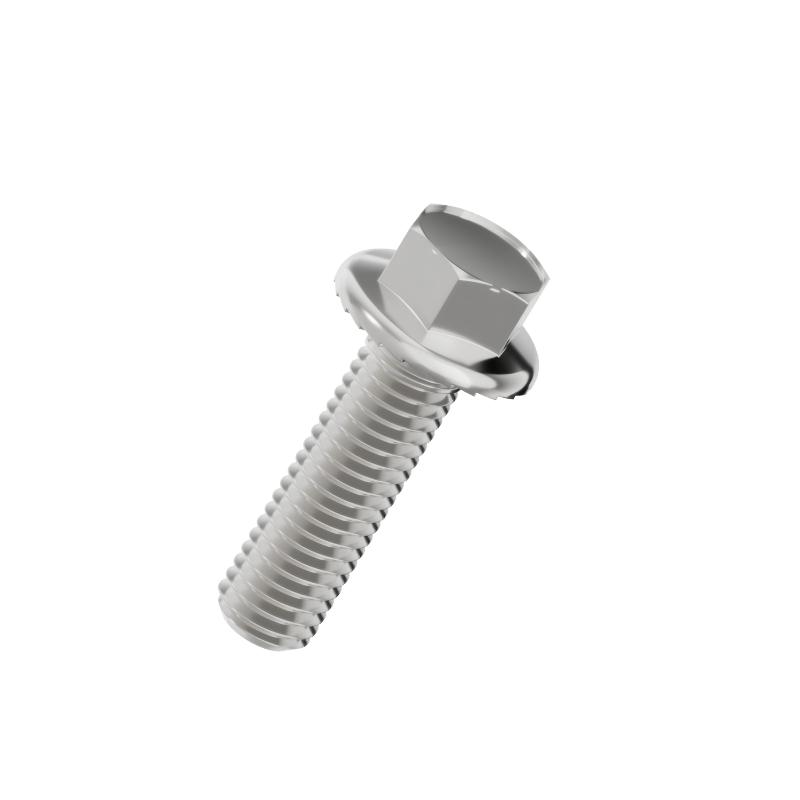
Hexagon flange bolt
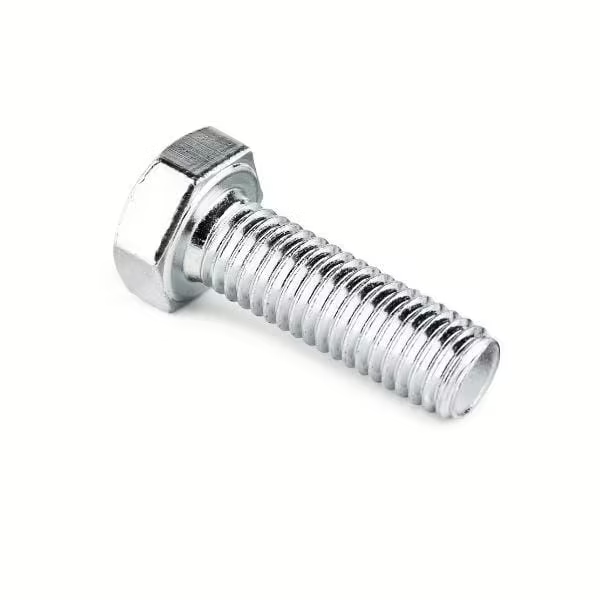
Our range of Hexagon Flange Bolts eliminates the need for a separate washer, offering a more efficient and secure fastening solution. These bolts feature an integrated flange with a serrated face under the hex head. The serrations "bite" into the mating surface, creating a locking mechanism that significantly reduces the risk of loosening due to vibration. Manufactured from premium stainless steel, they are the ideal choice for automotive, solar, and industrial assemblies where long-term stability is required.
- Serrated Locking Design: The toothed flange face grips the surface material, providing excellent resistance to rotational loosening under dynamic loads.
- Material Choice: Available in both Stainless Steel 304 (A2) for standard corrosion resistance and 316 (A4) for marine and harsh chemical environments.
- Efficiency: The one-piece design replaces the traditional bolt-and-washer combination, speeding up assembly lines and simplifying inventory management.

What is a Serrated Flange Bolt?
A hexagon flange bolt is a one-piece fastener that combines a hex head and a washer-like flange. Specifically, our bolts come with a serrated bearing face. When tightened, these angled teeth embed themselves slightly into the workpiece. This creates a ratchet-like effect: the bolt can be tightened easily, but the teeth dig in to resist the reverse motion, preventing the bolt from backing out. This self-locking feature makes them superior to standard bolts for machinery and vehicles.Material Selection Guide: 304 vs 316
Choosing the right grade of stainless steel is crucial for the longevity of your project. We offer two main categories: Stainless Steel 304 (A2): This is the most popular grade for general-purpose use. It offers excellent resistance to atmospheric corrosion, rain, and freshwater. It is widely used in automotive trim, solar racking, and interior architecture. If your application is not exposed to salt water or aggressive chemicals, SS304 is the cost-effective choice. Stainless Steel 316 (A4): Often called "marine grade," SS316 contains molybdenum, which drastically improves its corrosion resistance. It is specifically designed to withstand chlorides, sea water, and industrial pollution. If your flange bolts will be used on boats, chemical plants, or coastal construction, SS316 is required to prevent pitting and rust.Quality Assurance
Fastener Core ensures that our stainless steel materials meet international standards. We can provide an EN 10204 3.1 Material Certificate upon request to verify the chemical composition. Please note that third-party inspection services are available for an additional fee.Industrial Applications
Serrated hex flange bolts are versatile components used across various sectors:- Automotive: Exhaust manifolds, engine brackets, and gearbox assemblies where vibration is constant.
- Solar Energy: Securing solar panel frames and racking systems (speed of installation and locking security).
- Electronics: Mounting components inside server racks and enclosures.
- Conveyor Systems: Moving parts in factories that require vibration-proof connections.