

316 Stainless Steel (designated as UNS S31600 in the Unified Numbering System and 1.4401 in European EN standards) is the second most specified austenitic stainless steel after Grade 304. Often referred to as “Marine Grade” stainless, its distinguishing metallurgical feature is the addition of 2.0% to 3.0% Molybdenum (Mo).
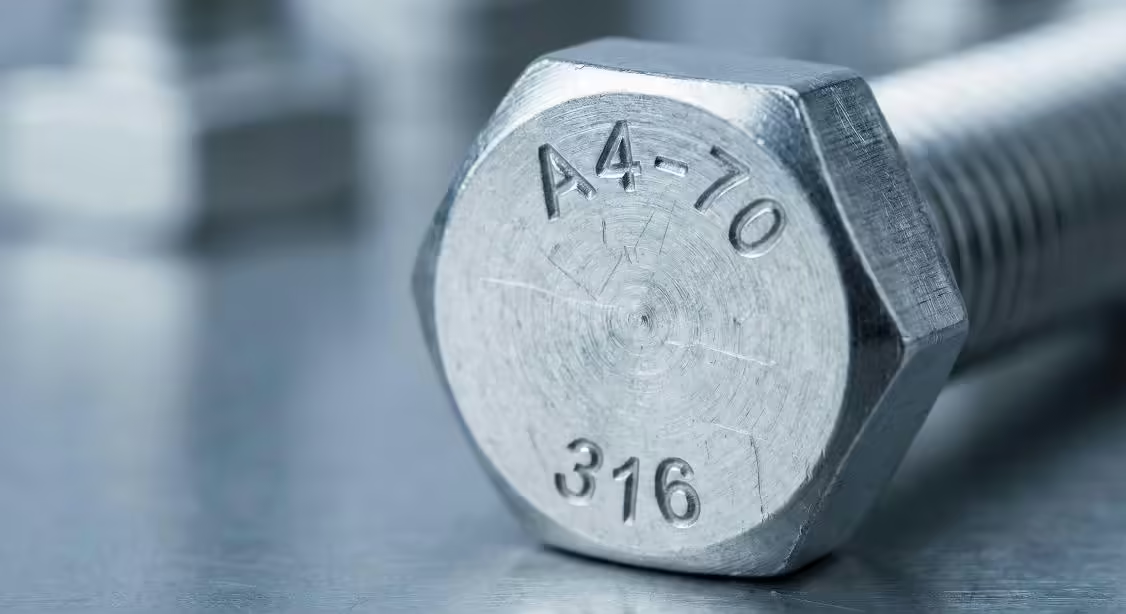
For engineering applications, this molybdenum addition provides a critical advantage over Grade 304: vastly superior resistance to chloride-induced pitting and crevice corrosion. While ASTM A276 covers the raw material specifications, fastener engineers typically reference ISO 3506 Class A4-70 for mechanical performance requirements.
1. International Standards & Cross-Reference Specifications
Grade 316 is standardized globally. Validating material test reports (MTRs) requires knowledge of equivalent designations across different standards bodies.
| Region / Body | Standard / Designation | Classification / Grade |
|---|---|---|
| USA (ASTM/AISI) | ASTM A240 / ASTM A276 | Type 316 |
| USA (UNS) | ASTM E527 | S31600 |
| Europe (EN/DIN) | EN 10088-3 | 1.4401 / X5CrNiMo17-12-2 |
| International (ISO) | ISO 3506 (Fasteners) | A4 Group (e.g., A4-70, A4-80) |
| Japan (JIS) | JIS G4303 | SUS 316 |
2. Chemical Composition (ASTM A240 / ASTM F593)
The defining characteristic of UNS S31600 is the Nickel-Chromium-Molybdenum formulation. The Molybdenum content is strictly controlled to ensure resistance to reducing acids and chlorides.
| Element | Symbol | Minimum % | Maximum % |
|---|---|---|---|
| Carbon | C | – | 0.08 |
| Manganese | Mn | – | 2.00 |
| Phosphorus | P | – | 0.045 |
| Sulfur | S | – | 0.030 |
| Silicon | Si | – | 0.75 |
| Chromium | Cr | 16.0 | 18.0 |
| Nickel | Ni | 10.0 | 14.0 |
| Molybdenum | Mo | 2.00 | 3.00 |
| Nitrogen | N | – | 0.10 |
Note: Grade 316L (UNS S31603) is the low-carbon version (Max 0.03% C), recommended for heavy gauge welded components to prevent sensitization.
3. Mechanical Properties
Similar to 304, Grade 316 relies on cold working (drawing/heading) to achieve high tensile values. In the fastener industry, specific property classes define the load-bearing capacity.
3.1 Raw Material Properties (Annealed Condition)
Comparison based on ASTM A240 / ASTM A276.
| Property | Metric (SI) | Imperial (US) |
|---|---|---|
| Ultimate Tensile Strength (UTS) | ≥ 515 MPa | ≥ 75 KSI |
| Yield Strength (0.2% Offset) | ≥ 205 MPa | ≥ 30 KSI |
| Elongation (in 50mm) | ≥ 40% | ≥ 40% |
| Hardness (Brinell) | Max 217 HB | Max 217 HB |
3.2 Fastener Specific Properties (ISO 3506-1)
For bolts, screws, and studs, 316 stainless falls under the Austenitic A4 group.
| Original Grade | Property Class | Tensile Strength (Rm) | Yield Strength (Rp0.2) |
|---|---|---|---|
| Type 316 | A4-50 (Soft) | Min 500 MPa | Min 210 MPa |
| Type 316 | A4-70 (Standard Cold Worked) | Min 700 MPa | Min 450 MPa |
| Type 316 | A4-80 (High Strength) | Min 800 MPa | Min 600 MPa |
4. Physical Properties
Physical constants for 316 are marginally different from 304 due to the higher Nickel and Molybdenum content.
- Density: 8.0 g/cm³ (0.29 lb/in³)
- Melting Range: 1370°C – 1400°C (2500°F – 2550°F)
- Modulus of Elasticity: 193 GPa (28.0 x 10⁶ psi)
- Thermal Conductivity (at 100°C): 16.2 W/m·K
- Thermal Expansion (0-100°C): 16.0 µm/m·K
5. Corrosion Resistance (The Molybdenum Advantage)
5.1 Chloride & Marine Environments
The primary engineering justification for selecting Grade 316 over 304 is chloride resistance. The definition of “corrosion resistance” in austenitic steel is often quantified by the Pitting Resistance Equivalent Number (PREN).
While Grade 304 has a PREN of approximately 18-20, Grade 316 typically achieves a PREN of 23-25. This increase signifies a substantially higher threshold against pitting in seawater, salt spray, and de-icing salt environments.
5.2 Chemical Processing
UNS S31600 demonstrates superior resistance to sulfuric acid (at lower concentrations), phosphoric acid, and acetic acid. It is also the standard specification for processing fatty acids at high temperatures.
6. Magnetic Properties & Demagnetization
Similar to 304, Grade 316 is often misunderstood regarding its magnetic behavior.
6.1 Induced Magnetism in A4 Fasteners
In the annealed condition, 316 stainless steel is virtually non-magnetic (Paramagnetic). However, the manufacturing of Class A4-70 and A4-80 fasteners involves aggressive cold heading and thread rolling. This mechanical work transforms a portion of the austenite phase into ferromagnetic martensite. Therefore, a high-strength 316 bolt will attract a magnet clearly on the thread and head.
6.2 Demagnetization Process
If an application demands near-zero magnetic permeability (e.g., particle accelerators, sensitive instrumentation), the fasteners must undergo Solution Annealing post-manufacturing:
- The component is heated to approximately 1050°C – 1100°C.
- Rapid quenching follows immediately to prevent phase separation.
- Result: The structure reverts to full austenite, eliminating magnetism.
- Trade-off: This process resets mechanical strength to the A4-50 level (Tensile ~500 MPa). High strength (A4-70/80) and zero magnetism are mutually exclusive in standard 316 fasteners without special processing (like nitrogen strengthening).
7. Application Engineering
Grade 316 is the mandatory specification for aggressive environments where 304 would fail via pitting or staining:
- Marine Hardware: Deck fittings, rigging screws, and underwater fasteners.
- Chemical & Petrochemical: Valves, pumps, and heat exchangers exposed to chlorides or acids.
- Medical Devices: Orthopedic implants and surgical instruments (often utilizing the Vacuum Melted 316LVM variant).
- Pharmaceutical Manufacturing: Tanks and pipework requiring high cleanability and resistance to aggressive sanitizing agents.
- Pulp and Paper: Equipment exposed to sodium compounds and bleaches.
Reference Standards Documents
Click below to expand and view the original standard documentation, or click “Download” on the right.
📄 ASTM A276 / A276M-23⬇ Download
📄 ISO 3506-1:2020⬇ Download
📄 JIS G 4303-2012⬇ Download
Disclaimer: The data presented in this specification sheet serves as a technical reference under standard testing conditions. Final material selection must be validated by a qualified engineer against specific application loads and environmental factors.
